

This is a technical guide for plant engineers, procurement managers, and EPC contractors. If you are looking for price quotations or custom thermic fluid heater manufacturing, visit our main product page here.
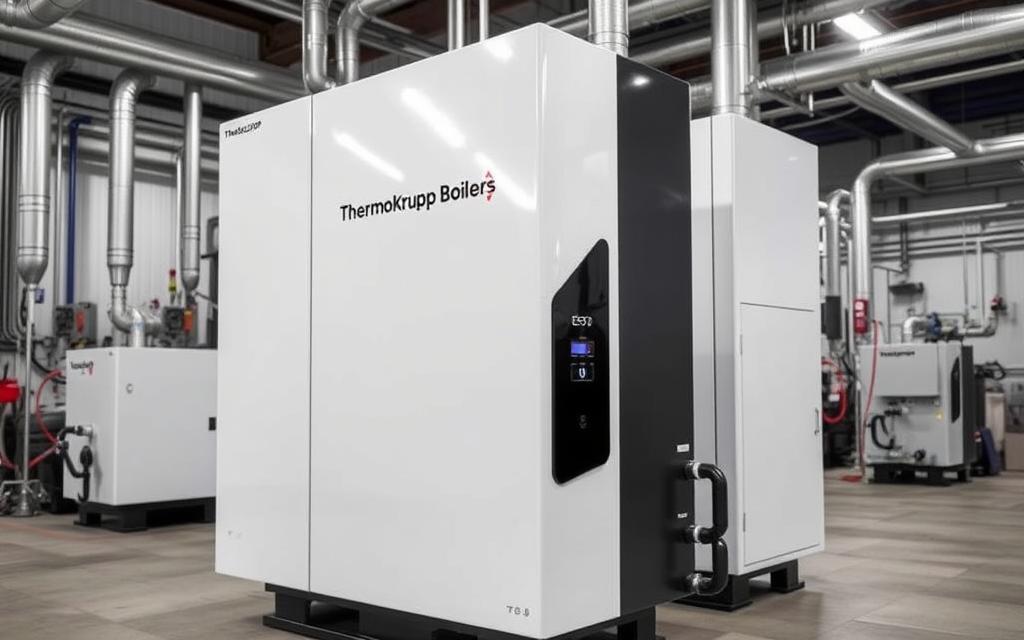
📌 Key Takeaways (For Engineers & Buyers)
- Maximum operating temperature: Up to 350°C (coil type) without high pressure.
- Thermal efficiency: 88% ± 2% on NCV for Thermokrupp models.
- Common fluids: Therminol 55, 66, Dowtherm A, and mineral oils.
- Typical applications: Bitumen heating, chemical reactors, plywood presses, textile stenters, pharmaceutical drying.
- vs Steam: Thermic fluid systems operate at atmospheric pressure at 300°C; steam requires 85 kg/cm² for same temperature.
1. What is a Thermic Fluid Heater? (Definition & Operating Principle)
A Thermic Fluid Heater (also called thermal oil heater or hot oil boiler) is an industrial heating system that circulates a liquid-phase heat transfer fluid through a coil heated by a burner. The fluid transfers heat to user equipment via heat exchangers, jacketed vessels, or presses.
Unlike steam boilers, thermic fluid heaters operate at atmospheric pressure even at 300°C+. This eliminates the need for licensed operators and high-pressure pipe codes in many jurisdictions.
How It Works (Step-by-Step)
- Burner fires into the radiant coil section.
- Heat transfers through coil wall to the thermal fluid.
- Hot fluid is pumped to the user equipment (reactor, press, dryer).
- Cooled fluid returns to the heater for re-heating.
- Closed-loop circulation continues with < 5% heat loss.
2. Types of Thermic Fluid Heaters: Coil Type vs. Shell & Tube
Thermokrupp manufactures both configurations. Your choice depends on fluid type, temperature, and fouling tendency.
| Feature | Coil Type (Vertical/Horizontal) | Shell & Tube Type |
|---|---|---|
| Max Temperature | Up to 350°C | Up to 400°C (with synthetic fluids) |
| Fluid Volume | Low (fast response) | High (thermal stability) |
| Maintenance | Easy coil replacement | Tube bundle cleaning required |
| Best For | Clean fluids, rapid cycling | High fouling applications, solid fuel firing |
3. Technical Specifications: Thermokrupp TK-TFH Series
All Thermokrupp thermic fluid heaters are IBR registered, ASME compliant, and CE certified for export.
| Model | Capacity (kcal/hr) | Max Temp (°C) | Fuel | Efficiency (NCV) |
|---|---|---|---|---|
| TK-TFH-50 | 50,000 – 1,00,000 | 300°C | Gas / Diesel | 88% |
| TK-TFH-150 | 1,50,000 – 5,00,000 | 320°C | Gas / Oil / Biomass | 87% |
| TK-TFH-300 | 5,00,000 – 30,00,000 | 350°C | Biomass / Coal / Oil | 86% |
| TK-TFH-SYN | Up to 50,00,000 | 400°C (Synthetic fluid) | Gas / Oil | 85% |
Custom configurations: Higher capacities, dual-fuel burners, skid-mounted packages, and explosion-proof controls available on request.
4. Heat Transfer Fluids: Selection Guide
Choosing the correct thermal fluid is as important as the heater itself. Below is the compatibility chart for Thermokrupp systems:
| Fluid Type | Max Bulk Temp | Max Film Temp | Application |
|---|---|---|---|
| Mineral Oil | 300°C | 320°C | General heating, presses |
| Synthetic (Therminol 55) | 320°C | 345°C | Chemical reactors |
| Synthetic (Therminol 66) | 345°C | 375°C | High-temp textile, pharma |
| Synthetic (Dowtherm A) | 400°C | 425°C | Specialized high-temp processes |
⚠️ Important: Never exceed the fluid’s maximum film temperature. Thermokrupp heaters are designed with low flux density coils to extend fluid life by 30-40%.
5. Energy Efficiency: How Thermokrupp Achieves 88% Thermal Efficiency
As an IBR-approved manufacturer with 25+ years of experience, we engineer efficiency into every component:
| Feature | Engineering Detail | Benefit |
|---|---|---|
| Radiant & Convection Coils | Two-pass design with extended surface | Maximizes heat absorption, lowers exhaust temp |
| Insulation | 100mm ceramic fiber + mineral wool | Shell temperature < 55°C at 350°C operation |
| Burner Management | Modulating control with O₂ trim | Optimizes air-fuel ratio at all loads |
| Fluid Velocity | Minimum 2.5 m/sec through coil | Prevents film boiling and carbonization |
Real-world result: A Thermokrupp 1,00,000 kcal/hr heater at a Punjab textile mill recorded 22% lower fuel consumption compared to their previous 20-year-old fire tube boiler running at 180°C.
6. Industry Applications (With Specific Process Details)
🛢️ Bitumen & Asphalt
Heating bitumen storage tanks and spray lines to 180°C. Direct-fired or indirect? Indirect preferred to avoid coke formation.
🧪 Chemical Reactors
Precise 250°C – 320°C heating for polymerization, distillation, and esterification. ±2°C accuracy with our PLC system.
🪚 Plywood & Laminates
Hot press platen heating. Multiple presses from single heater. Thermal fluid up to 220°C with no pressure.
👕 Textile Stenters
Drying and heat-setting. 180°C – 220°C oil temperature, indirect air heating via finned exchangers.
“Thermokrupp supplied a 5,00,000 kcal/hr solid fuel thermic fluid heater for our plywood division in 2023. The actual thermal efficiency measured during commissioning was 87.4%, exactly as guaranteed. Coil metal temperatures are monitored and recorded—no hotspots after 18 months of continuous operation.”
— Senior Maintenance Manager, Century Plyboards (Confidential Reference)
7. Thermic Fluid Heater vs. Steam Boiler: Selection Criteria
| Parameter | Thermic Fluid Heater | Steam Boiler |
|---|---|---|
| Temperature at Pressure | 350°C @ 1 bar | 350°C @ 85 bar |
| Phase Change | No (liquid only) | Yes (water to steam) |
| Operator License | Not required (below IBR limits) | Mandatory |
| Corrosion | None (closed loop) | Oxygen pitting, scale |
| Best For | Processes above 200°C | Processes below 180°C, humidification |
Verdict: If your process requires >200°C, thermic fluid is safer, more efficient, and lower maintenance. Below 180°C, steam remains competitive.
8. Quality Certifications (Verified)
| Certification | Scope |
|---|---|
| IBR (Indian Boiler Regulations) | All pressure parts designed, welded, and tested per IBR 1950. |
| ISO 9001:2015 | Quality management systems – certified by TÜV. |
| CE Marking | PED 2014/68/EU compliant for export to Europe. |
| ASME Stamp (U-Stamp) | Available on request for North American projects. |
📄 Certificate copies: Provided with every proposal. Third-party inspection (TÜV, BV, Lloyds) can be arranged at client cost.
Conclusion: Use This Guide, Then Contact Our Engineers
You now have the technical data to evaluate thermic fluid heaters against your process requirements.
- ✅ You need 200°C – 350°C? Thermic fluid is optimal.
- ✅ You need 350°C – 400°C? Synthetic fluids required.
- ✅ You need custom coil metallurgy, controls, or fuel? We manufacture it.
For a detailed quotation, system drawings, or to visit our Dadri factory:
📞 Speak to a Thermal Fluid Specialist
📱 +91 99119 35013
✉️ sales@thermokruppboilers.com
❓ Frequently Asked Questions (Thermic Fluid Heaters)
What is the maximum temperature of a thermic fluid heater?
Mineral oil systems: 300°C – 320°C. Synthetic fluids (Therminol 66, Dowtherm A): 345°C – 400°C. Beyond 400°C, electric heating or molten salt systems are required.
What is the difference between coil type and shell & tube thermic fluid heaters?
Coil type: Faster response, lower fluid volume, easier coil replacement. Shell & tube: Higher fluid volume (thermal buffer), easier cleaning for fouling fluids, preferred for solid fuel firing. Thermokrupp manufactures both.
Which is better: thermic fluid heater or steam boiler?
For process temperatures above 200°C, thermic fluid is safer and more efficient. For below 180°C, steam is often more economical. The crossover point depends on pressure vessel codes and operator availability.
How long does a thermic fluid heater coil last?
With proper fluid maintenance and flux density below 45,000 kcal/m²hr, coil life exceeds 15–20 years. Thermokrupp designs conservatively; we use thicker tubes than ASME minimum.
Do you manufacture solid fuel (biomass/coal) thermic fluid heaters?
Yes. We offer fully automatic solid fuel firing systems with stepped grate or moving grate furnaces. Capacities up to 30,00,000 kcal/hr. Shell & tube configuration recommended for solid fuels.